
3D printing and 3D scanning: The way forward for cable carriers in intralogistics?
Additive manufacturing accelerates development and individualisation
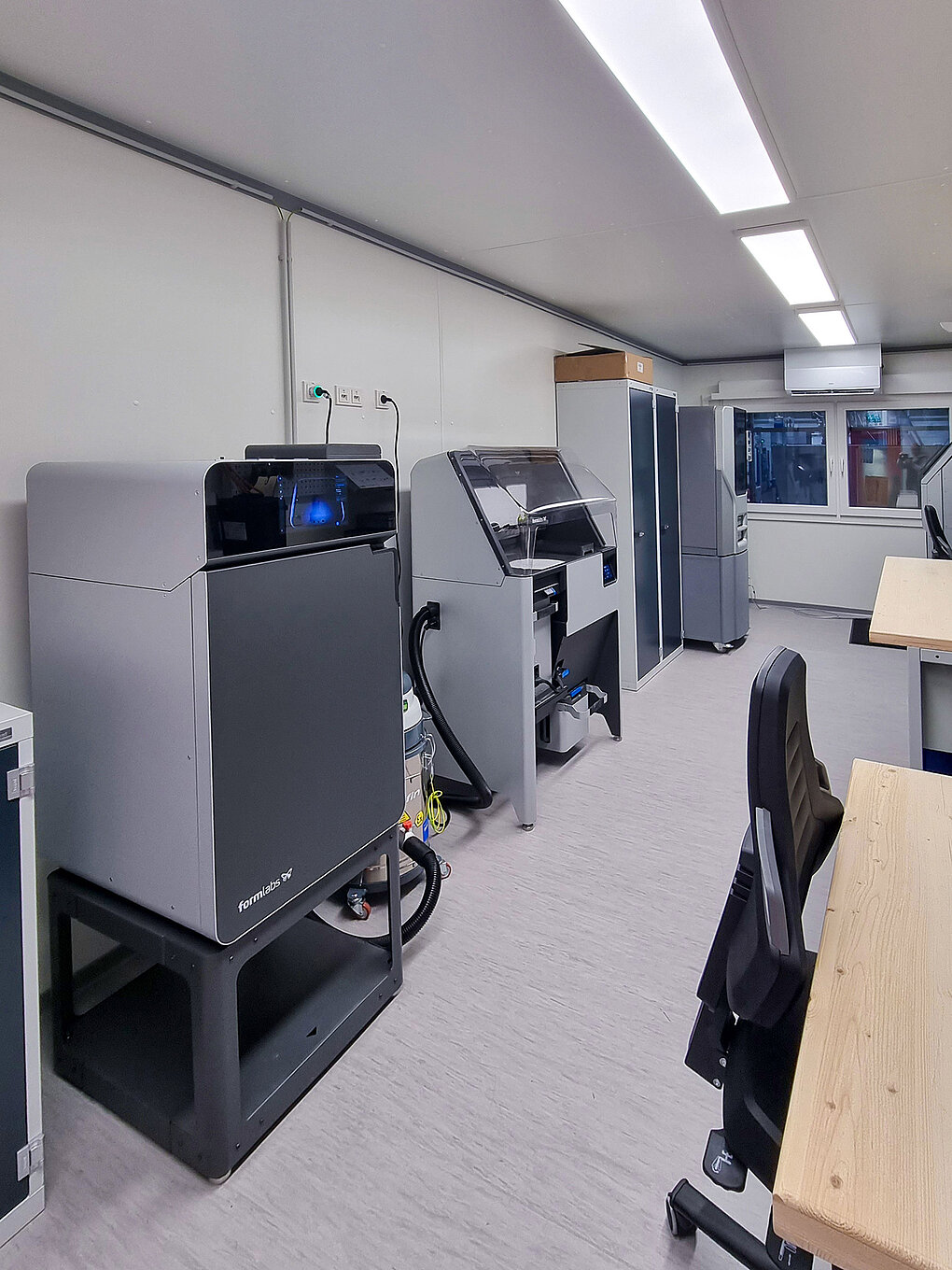
TSUBAKI KABELSCHLEPP has consistently structured its additive manufacturing as a container solution. The printers, processing system and periphery are all placed in an all-weather container that is managed like an injection moulding machine, including the connection to the ERP system.
Image: TSUBAKI KABELSCHLEPP
Cable carriers are central components for reliable guiding of energy and data cables in dynamic applications such as crane systems, conveyor systems, robotics and automated storage systems. They reliably protect cables and minimise downtime that can quickly become expensive. The increasing level of automation is a challenge in the field of intralogistics. It also leads to ever more data having to be transferred and accordingly more cables that require reliable management. At the same time, the requirements for variant diversity, installation space integration and service life of the cable carrier are increasing. This means that the development processes have to become faster, more flexible and also more economical.
In light of all this, TSUBAKI KABELSCHLEPP are using 3D printing and 3D scanning as specific tools to increase efficiency in product development. The advantages: Printed prototypes can be tested mechanically already during early phases and then trialled in the actual installation. Designs can be optimised without cost-intensive tool changes. The effects are measurable. Iteration loops are cut down significantly, the materials required for prototypes are reduced by up to 80 per cent and development periods become much shorter.
SLS as an industrial manufacturing process
Selective laser sintering (SLS), which is used by TSUBAKI KABELSCHLEPP, has become established as a robust process for industrial prototype and small-batch production. The dimensional tolerances are in the range of ±0.2 mm plus a percentage of the part length. A characteristic feature is that there are no supporting structures, which makes it possible to produce even complex geometries without additional steps. This opens up new flexibilities for designing cable carriers, for example in terms of integrated functions or geometrically optimised parts.
TSUBAKI KABELSCHLEPP are currently using additive manufacturing for functional tests, small-batch runs or customised components. The new technology is structured as a container solution and managed like an injection moulding machine, including a connection to existing production and ERP structures. This ensures predictable processes, a high level of quality and complete traceability.
The manufacturing process follows the task at hand
This offers clear benefits for intralogistics applications and projects: quick availability of samples, reduced project risks and economical individualisation even for small runs. At the same time, additive manufacturing remains a supplementary process at TSUBAKI KABELSCHLEPP with defined limits, for example in terms of material variety and surface quality. “In our concept, the manufacturing process follows the task at hand,” explains Peter Pütz, Vice President Marketing & Innovation at TSUBAKI KABELSCHLEPP. “If additive manufacturing is the best solution, we use it. If injection moulding is the superior choice, we use that. And if both together offer the best solution, we combine them.”
(3,255 characters incl. spaces)
About TSUBAKI EUROPE HOLDINGS B.V.:
The TSUBAKI Group is one of the world’s leading manufacturers of drive and conveyor technology and of mechatronic solutions. With TSUBAKI EUROPE HOLDINGS B.V., based in Dordrecht, Netherlands, the company brought its European companies together under a joint umbrella in 2026, strengthening the collaboration across national and company borders. The core members of the new holding company are TSUBAKIMOTO EUROPE B.V. (Dordrecht), TSUBAKI KABELSCHLEPP GmbH (Wenden-Gerlingen), MAYFRAN INTERNATIONAL B.V. and MAYFRAN LIMBURG B.V. (Landgraaf), TSUBAKI JUNGBLUTH GmbH (Bad Hersfeld) as well as other European subsidiaries. Together, they develop and manufacture high-quality products and system solutions for different industries – from cable carriers and cable protection systems, chains and drive components to solutions for chip disposal and coolant management as well as for WtE (Waste to Energy) applications. With bundled European know-how, great power of innovation and a strong international presence, TSUBAKI stands for quality, reliability and customer focused solutions from a single source.
(1,099 characters incl. spaces)
DOWNLOAD
Press Release “3D printing and 3D scanning: The way forward for cable carriers in intralogistics?”
14. Sep 2026
3255 Zeichen, 2 Bild(er)
5,393,374 KB

Additive manufacturing changes the development of cable carriers for intralogistics. TSUBAKI KABELSCHLEPP focuses specifically on 3D printing and 3D scanning to reduce development times, save materials and implement customised solutions in an economically viable manner.
Image: Cimcorp Oy
14. Sep 2026