TSUBAKI KABELSCHLEPP plans climate neutrality before 2045
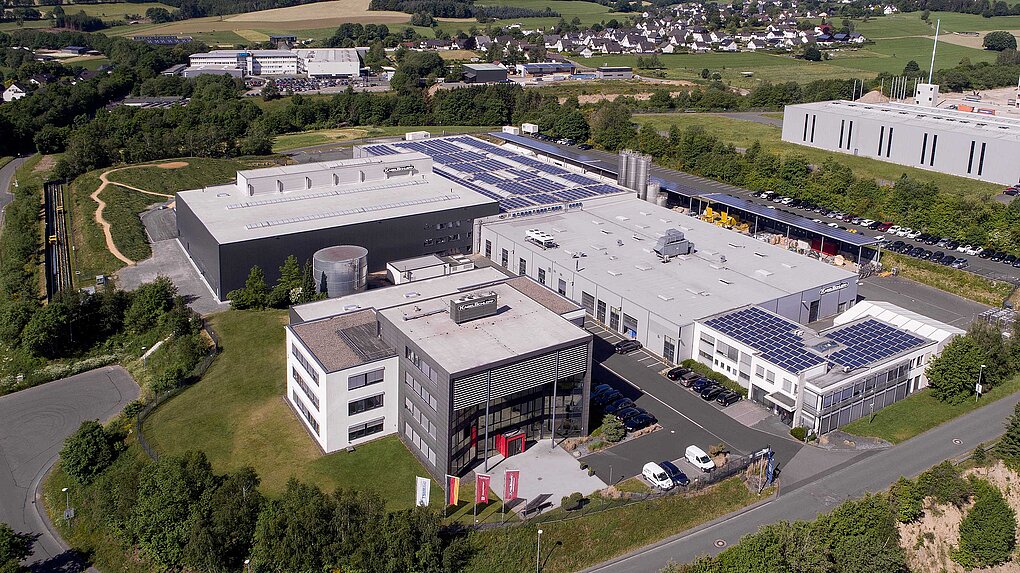
Between 2018 and 2022, TSUBAKI KABELSCHLEPP was able to reduce its CO2 emissions at the Wenden-Gerlingen site by 20 % in scope 1 and by 100 % in scope 2. The total reduction during this period in both categories was 79 %, which corresponds to CO2 savings of 1,138 t CO2e.
Image: TSUBAKI Kabelschlepp
“It is our objective to achieve climate neutrality well before 2045,” explains Henning Preis, President & CEO at TSUBAKI KABELSCHLEPP. “We accept sustainable actions as our corporate and social responsibility and therefore already launched our sustainability initiative several years ago.” He explains that it is very important to the company to keep a good balance between the three pillars of sustainable actions – ecology, economy, and social aspects.
The Greenhous Gas (GHG) Protocol distinguishes between three categories or scopes for the emissions of a company. Scope 1 comprises the direct sources such as natural gas, crude oil, and fuels for company vehicles. Scope 2 adds emissions from indirect sources by purchasing electricity. All other emissions, including those arising in the supply chain, are added to scope 3.
Between 2018 and 2022, TSUBAKI KABELSCHLEPP was able to reduce its emissions by 20 % in scope 1 and by 100 % in scope 2. The total reduction during this period in both categories was 79 %, which corresponds to CO2 savings of 1,138 t CO2e. The change from gray electricity to green electricity in early 2022 was a substantial factor in this. This measure resulted in a reduction of the CO2 emissions by 1,035 t CO2e. But the annual power consumption itself was also reduced by 13.7 % during the calculation period. Emissions from burning natural gas and fuels was reduced by 20.8 % compared to 2018. Large scopes of the emissions in scope 3 were already recorded and integrated in the current site analysis.
Identifying savings potentials, defining measures
A prerequisite for these and other savings is to generate product-related, process-related, and site-related CO2 analyses. Based on the data already acquired, it was possible to identify savings potentials and define targeted measures. The first sustainability projects have now been completed. The waste heat from compressors and injection molding machines, for example, is used for heating the administrative offices and for heating the conditioning basins. During spring and fall, this results in gas savings of more than 80 %.
Among other things, the existing fluorescent tubes in the assembly shop were replaced with 214 LED light strips to reduce electricity consumption. In addition to this, a third of the injection molding machines used already have a frequency control, which reduces energy consumption by up to 50 %. In the coming years, all conventional injection molding machines are set to be replaced with energy optimized models.
“At the Wenden site and in subsidiaries with production, we will reduce CO2 emissions significantly in the coming years,” Henning Preis sums up.
DOWNLOAD
Press Release “TSUBAKI KABELSCHLEPP plans climate neutrality before 2045”
12. Jul 2023
3123 Zeichen, 2 Bild(er)
4,414,196 KB
12. Jul 2023